
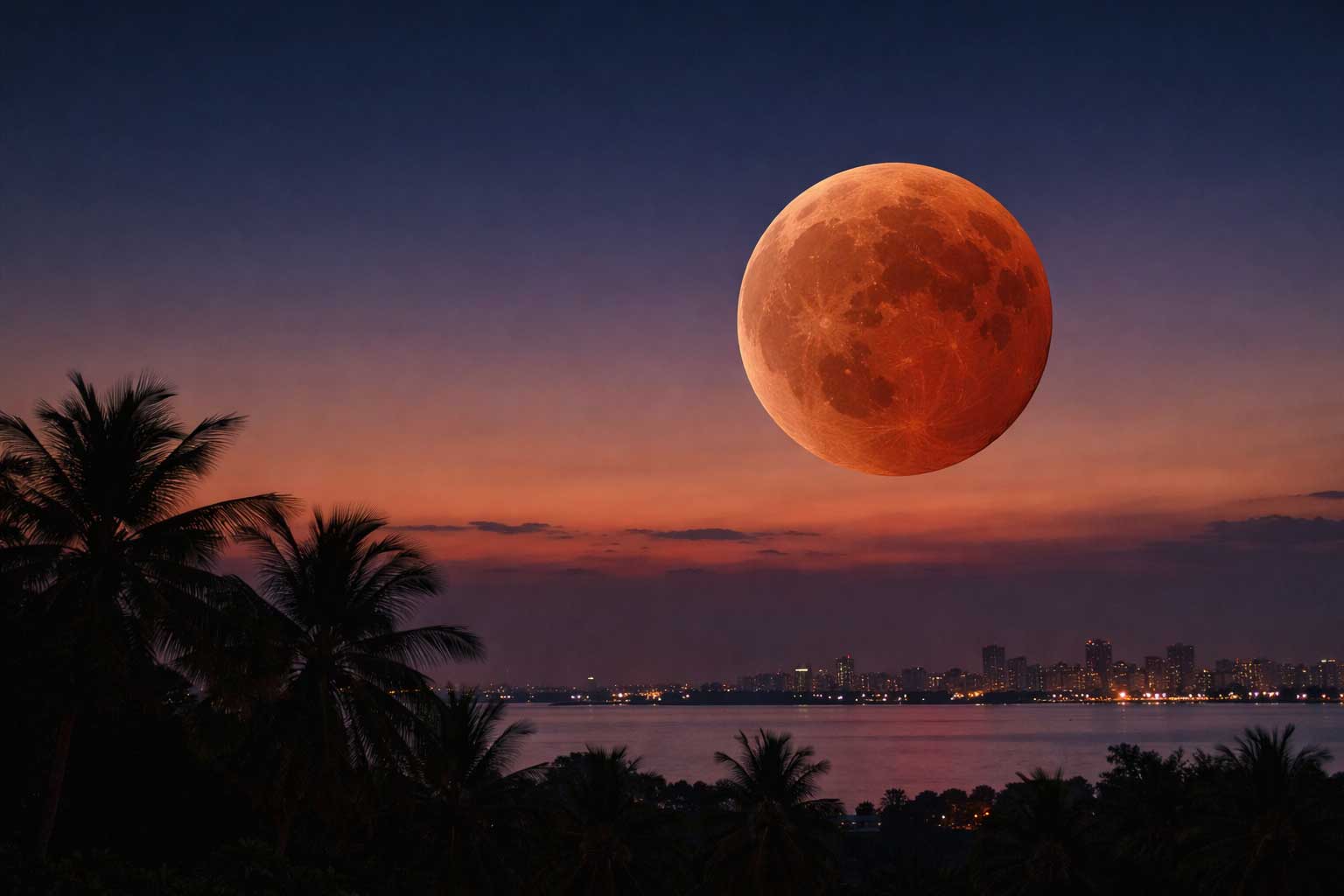
What Time Is the Blood Moon in the Philippines on March 3?
MANILA, Philippines — A total lunar eclipse, commonly known as a “blood moon,” will be visible across the Philippines on Tuesday, March 3, 2026. Totality will begin at 7:04 PM Philippine Standard Time (PHT) and peak at 7:34 PM, according to the Philippine Atmospheric, Geophysical and Astronomical Services Administration (PAGASA).
The Moon will already be partially eclipsed when it rises at 5:58 PM, giving observers nationwide an opportunity to witness the event without special equipment, weather permitting.
Eclipse Schedule (Philippine Standard Time)
Based on astronomical data released by PAGASA, the key phases of the eclipse are as follows:
- Moonrise – 5:58 PM
The Moon rises already in a partial eclipse. - Totality Begins – 7:04 PM
The Moon becomes fully immersed in Earth’s umbral shadow. - Maximum Eclipse – 7:34 PM
The Moon reaches the deepest point within Earth’s shadow. - Totality Ends – 8:03 PM
The Moon begins to exit the umbra, and the reddish coloration gradually fades. - Partial Phase Ends – 9:17 PM
The Moon leaves Earth’s main shadow. - Eclipse Ends – 10:25 PM
The penumbral phase concludes.
Totality is expected to last approximately 59 minutes.
Why the Moon Turns Red
A total lunar eclipse occurs when Earth passes directly between the Sun and the Moon, casting a shadow on the lunar surface. During totality, the Moon may appear coppery red or dark orange.
According to PAGASA, the reddish color results from sunlight filtering through Earth’s atmosphere. Shorter blue wavelengths are scattered, while longer red wavelengths are refracted into Earth’s shadow and illuminate the Moon.
The exact shade observed can vary depending on atmospheric conditions, including the presence of dust or volcanic particles.
National Visibility
The eclipse will be visible throughout the Philippines, provided skies remain clear. Observers are advised to look toward the eastern horizon shortly after sunset, as the Moon will be low in the sky at the start of the event.
Unlike solar eclipses, lunar eclipses are safe to view with the naked eye. No special filters or protective eyewear are required. Binoculars or telescopes may enhance surface details but are not necessary.
Why the Event Matters
Total lunar eclipses visible during evening hours are relatively accessible events for the general public. Because the March 3 eclipse occurs shortly after moonrise, it offers convenient viewing conditions for students, schools, and astronomy groups across the country.
Lunar eclipses also provide educational opportunities to better understand the Earth-Moon-Sun alignment and orbital mechanics. While lunar eclipses occur globally several times per year, total eclipses visible from a specific region are less frequent.
PAGASA regularly publishes astronomical diaries to inform the public of such events and encourages responsible sky observation.
Background
Lunar eclipses have been documented for centuries and remain among the most widely observed astronomical phenomena. They occur when the Earth’s shadow falls on the Moon during a full moon phase.
Because the entire event is visible to anyone on the night side of Earth, lunar eclipses are accessible to a broad audience without specialized instruments.
As of this writing, PAGASA has confirmed the March 3, 2026 schedule for Philippine observers. Residents are advised to monitor local weather updates on the day of the event to determine viewing conditions in their area.

Leave A Comment